























Technical: The mechanics behind the Heart Return
Raj Aditya Chaudhuri
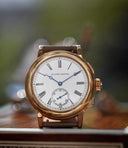
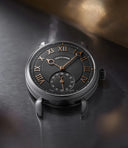
Watchmaker Bernhard Zwinz started with a blank sheet when dreaming up what became the calibre CW03. It powers his latest reference, evocatively named Heart Return, and Zwinz worked on the movement for six years, layering historical inspiration with mechanical novelty.
The end result is a movement that centres two functions. The first of these is the zero-second reset or Heart Return function that gives the watch its name. The second is the jumping power reserve indicator. While both are unusual, one is wholly novel to modern watchmaking. Crucially, both are interpretations of advances championed by 19th century Austrian master Joseph Thaddäus Winnerl whose name and philosophy his compatriot Zwinz aims to perpetuate.
J. Th. Winnerl is best remembered for his development of the heart-shaped cam, a deceptively simple mechanism that became fundamental to the reset function of modern chronographs. Already in 1831, he had employed the cam in a pocket watch with a seconds hand that the wearer could stop and restart independent of the movement, allowing the measurement of elapsed time without interrupting timekeeping.
In the years that followed, he expanded this principle by developing a set up with twin co-axial seconds hands that could be stopped and reset, laying the groundwork for what would later become the split-seconds chronograph. By 1840, J. Th. Winnerl had further developed these ideas into increasingly complex recording mechanisms, including what is considered the first triple split chronograph.
His other major contribution was the creation of remarkably compact and accurate marine chronometres for the French navy. One such marine chronometre, No. 80, has been particularly inspiring to Zwinz causing him to begin charting the story of the rebirth of the Winnerl name almost 10 years ago.
In the calibre CW03, Zwinz has threaded together these two chapters of J. Th. Winnerl’s history towards a simple pursuit: “A watch should allow the wearer to set time precisely and understand the passage of time clearly” he says.
In this article we investigate the mechanical novelty Zwinz employs towards these seemingly elemental pursuits.

The balance

While seen before both in the Founders’ and Tremblage Series of watches, it is worth considering the unique form of the balance wheel as a starting point to this discussion. Crafted from a beryllium copper alloy and 13mm in diameter, the 45° banked rim of the balance wheel is furnished with two sets of twin round-headed white gold inertia weights, positioned across from each other for maximum poise. For the same reason, four stainless-steel adjustable timing screws are placed equidistant from each other.
The banked form means that both inertia and timing weights are at a diagonal angle to the plane of rotation of the balance wheel. According to Zwinz, in this orientation each turn of the timing screw has only half the effect than if the screws were situated horizontally or vertically (at a 90º angle as is generally the case) to the plane of rotation of the balance wheel. Consequently, finer adjustments can be made to the timing screws in Zwinz’s balance wheel.
It is worth noting that Zwinz first encountered the bowl-shaped architecture of the balance wheel in J. Th. Winnerl’s marine chronometer No. 80. It remains a historically accurate mainstay of the modern independent.
The mainspring barrel
Understanding the jumping power reserve display requires an appreciation of the novel mechanics of the energy source in the calibre CW03. Zwinz employs an unusual stop-work architecture in the mainspring barrel. It is yet another instance of the watchmaker deploying micro engineering to the end of stable chronometry.
Instead of the traditional Maltese cross stop-work, Zwinz uses a gear with internal teeth and a stop-finger to prevent over-winding.

The beauty of this set up is that the seemingly pedestrian stop-finger also stops the barrel’s rotation on the outer extremes of the mainspring’s wind. This is predicated on the understanding that in its fully wound state, the mainspring holds too much torque while as it is about to come fully unwound, its turning force is inadequate. Neither of these extremes is ideal for stable chronometry.
The stop-finger is employed here to block the mainspring barrel from being fully wound. Only the ‘middle’ portion of the mainspring’s reserve – characterised by predictable quanta of torque ideal for linear chronometry – is available.
Jumping power reserve indicator
When Zwinz was hoping to add a power reserve complication to Winnerl vernacular, he again sought inspiration in the marine chronometre No. 80. That watch contained a solution to a problem that is true of almost all power reserve set ups. The complication typically requires constant surveillance of the reserve in the mainspring barrel, with a cam-mounted indicator hand on the dial exerting a constant irregular drag on the barrel while doing so. Such friction is of course ill-suited to the mainspring’s purpose of delivering steady torque.
Zwinz’s solution, like in the No. 80, is to take just seven reads over the course of the 49 hours of chronometric reserve in the mainspring barrel. The rest of the time, the mainspring barrel is under no strain from the marine chronometre-style power reserve display.
Zwinz says, “Most power reserve indicators today show what remains in the mainspring. In J. Th. Winnerl's marine chronometers, from the 1830s onwards, however, the indication reflected the energy that had already been used. This approach aligns closely with J. Th. Winnerl's spirit: measuring and understanding the passage of time rather than predicting what remains.”

There is beauty in the straightforward logic of the display and the mechanics beneath the surface. The eight-part display lies in the southern half of the dial, the counterpart to the running seconds in the northern portion. The fan-style power reserve display is graduated into eight parts, from zero to 49 hours since the mainspring was fully wound, with seven hours in between markers.
Key to its mechanics is a small differential, with its two wheels coupled by means of precisely engineered 90° jewelled gearing in between them – the top wheel interacts with the winding barrel ratchet wheel via an intermediate wheel while the lower wheel one interacts with the barrel. Zwinz explains, “The use of a differential was mainly a question of compactness. It allows several interactions for different functions within a very small space while keeping the overall architecture clear and efficient.”
Under this differential and linked to it, lies a wheel with a single finger that interacts with an eight-pointed star wheel.
Winding the crown sets in motion the differential and the single-finger wheel, with the sequence of actions being converted into mainspring reserve. With each full rotation of the differential and the single-finger wheel, the latter advances the star wheel by one position. Each notch of the star wheel corresponds to one of the eight graduations of the power reserve indicator on the dial. Each full rotation of the differential and single-finger wheel results in a single jump of the hand plying the power reserve to the next position.

End of life - Balance stop
The power reserve, which in many ways is the central attraction of this reference, has another interesting character. The mainspring barrel has some reserve left in it after the power reserve indicator reaches the last (49 hour) mark. At that point the wearer has about three hours to wind the mainspring, failing which, at the end of this period, the balance is stopped.
It is worth noting that when this happen the mainspring still has almost a full extra day of reserve remaining – this is not employed towards timekeeping though. Zwinz says, “These additional hours are not wasted energy. They act as a buffer at the lower end of the mainspring's optimal torque range, ensuring that the movement restarts reliably once the watch is rewound”.
On the other side of the differential lies another star wheel also paired with the same single-finger wheel. The single-finger wheel's advance and retreat moves both star wheels in the same rotation. The second star wheel is responsible for the end-of-life function – it has one deeper or ‘action’ notch. When the single-finger wheel engages the action notch, it sets in motion a lever which stops the balance wheel and brings the watch to a controlled stop.
Zwinz says, “The intention is not simply to let the watch run down naturally, but to conclude the running cycle in a defined and mechanically stable state”.

Heart return – Zero-second reset
This function, aimed at precise time-setting, is best explained by following the sequence of actions when the crown is pulled out. It begins with a lever that engages a column wheel, advancing it by one position every time the crown is engaged. The inclusion of a column wheel design is unusual for a zero-second reset function – Zwinz’s reason was that the interaction between the lever and the column wheel eliminates almost all possibility of errors in engagement or slippage. Pulling the crown out starts the chain of actions that resets the resets indicator reliably.

As the crown and winding stem are pulled out, a coordinated sequence of actions is initiated throughout the movement. A parallelogram lever, operating on two levels, advances the column wheel by one step every time. Its rotation releases the stop lever, thereby freeing the fixed gear that it was blocking. On the opposite side, a spring-loaded rounded hammer falls onto the heart-shaped cam – that carries the seconds hand on an extended pinion – settling in its recessed part. This reset position of the cam corresponds to the seconds hand shooting back to the 0/60 position.
A compact differential on this extended pinion allows this reset to occur without disturbing the stability of the gear train, enabling the actions to happen simultaneously and smoothly.
At the same time, a second balance stop lever arrests the balance wheel, allowing for precise time-setting.


A glimpse into the mechanics underpinning the heart-shaped cam. On the right is an isolated view of the differential on the extended pinion that links the heart-shaped cam on the movement side to the seconds indicator on the dial side.
Heart on the sleeve
While the heart-shaped cam is usually buried deep within the mechanics of movements, owing to history Zwinz draws from, the watchmaker has made it the focal point of the view from the movement side. Visible in the sea of fine Côtes de Genève on the three-quarter plate lies a circular aperture that exposes the graté finishing on the bridge underneath. Visible here are the heart-shaped cam and the circular hammer that engages it, the two components isolated to allow the wearer a view of this rarely celebrated mechanism.
This is made possible because of a long pinion that runs across the movement, linking the seconds hand on the dial side with the heart-shaped cam. However, it isn’t just a simple pinion. The gearing underpinning the seconds hand needs to interact with other parts of the gear train and these interactions are managed using the differential set up we described in the previous section.

While such a show of mechanics might seem at odds with Zwinz’s restrained philosophy, the watchmaker cites historic precedence for this rare instance of flamboyance. He says, “For both J. Th. Winnerl and me, the philosophy of movement design has never been to reveal as much as possible simply for visual effect. The intention is always that form follows function, with robustness, longevity and chronometric stability remaining the primary goals.
“In this case however, the decision to make the zero-reset system visible was very deliberate. The heart-shaped cam is one of Winnerl's most important inventions. It became such a standard solution that its originality and function are almost forgotten today, even though the same principle can be found in virtually every mechanical chronograph and stopwatch since the 1830s,” Zwinz says. “Because the movement was developed from a blank page, the architecture could be arranged so that this mechanism can be easily understood while remaining discreet and mechanically robust.”
Final word
It is fitting to think of the Heart Return as a furthering of Winnerl’s repertoire. Yet it remains firmly within the historic context of the master watchmaker’s work. That Zwinz continues the trajectory of miniaturisation that began with J. Th. Winnerl’s marine chronometres, by bringing innovations like the jumping power reserve to a wristwatch, is also satisfying.
It is the result of a long gestation and when asked about the Heart Return brings him the most joy Zwinz says, “As is often the case in watchmaking, many small details contribute quietly to the overall logic and stability of the movement. What I enjoy most is the coherence of the mechanics. The mathematics – the jumping power reserve, the star wheel, and the differentials – all belong to the same mechanical logic. Nothing is there for effect; each element serves precision and clarity. That way of thinking is very close to what I admire in Winnerl's work: simple mechanical ideas, carefully executed and finished, all in service of precise timekeeping.”
We would like to thank Bernhard Zwinz for taking the time to explain the beautiful mechanics of the calibre CW03.